
Predictive maintenance through vibration monitoring
Know which machine needs you, what is wrong and what to do, before it stops the line.
Wireless sensors on your critical machines, a mobile vibration analysis app for your technicians' rounds, and one web platform where both meet. Osilera watches your motors, pumps, fans and rolls and turns a change into a planned job.
- ISO 20816
- Wireless sensors
- Mobile vibration analysis app
- Limits per machine
- Cloud or your own servers


An unplanned stop costs far more than the repair.
When a motor, a pump or a roll bearing fails without warning, the line stops. You lose production, pay for overtime and rush parts, and put people at risk. Yet most of these faults announce themselves well in advance, if someone is listening.
Run to failure
The repair happens when the machine decides, usually at the worst moment.
Maintenance by the calendar
Good parts are changed too early, and failing ones are missed between two visits.
Periodic readings miss things
A monthly manual reading sees a machine twelve times a year. Machines behind guards or up high are skipped.
Few analysts, scattered data
Vibration experts are scarce and readings sit in different tools. Nobody has time to read the charts.
A machine shows wear in its vibration long before it fails. Measure the vibration regularly, and you repair at a stop you choose, not one the machine chooses.
How a bearing fails, and when each measurement sees it
Typical progression over weeks to months. Watching only the overall vibration level sees the fault late; the bearing band and impacts show it early, while there is still time to order the part and plan the stop.
Sensors on the critical machines, an app for the rounds, one platform for both.
Osilera covers both ways of measuring a plant: continuously on the machines that matter most, and with periodic readings for all the others. Every reading ends up on the same machine and measuring point, in one history.
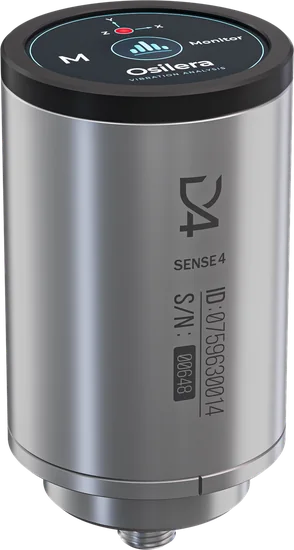 Osilera Monitorsensor on each critical machine
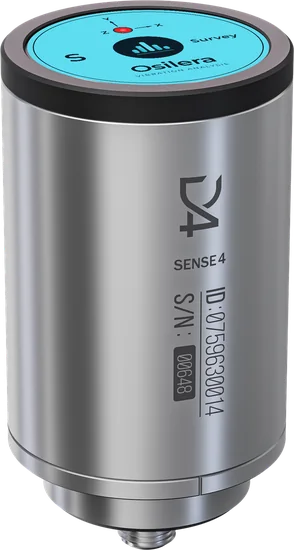
Continuous, on the critical machines
A wireless sensor fixed on the machine by stud, adhesive or magnet. It measures vibration on three axes, shaft speed and temperature around the clock. Battery: about 4 to 6 years, by model.
Osilera MonitorA mobile vibration analysis app
A sensor and a phone or tablet app for the technician. The app grades each reading to ISO on the spot and names the likely fault and the next step. It works offline, in Turkish and English.
Osilera SurveyWhere both meet
It checks every machine, turns a change into a task for your team, and keeps the whole history of each measuring point.
Osilera WebEvery machine is checked twice, and every change becomes a job.
Measure
Monitor sensors send a reading on a set schedule, typically every 5 minutes. Technicians add periodic readings with the Survey app.
Judge
Each machine is checked against the ISO 20816 zones for its power and mounting, and against its own normal level, learned from about a day of running.
Act
A change becomes a task on the Today list, with its likely cause and what to do. It can also reach you by e-mail.
Fewer false alarms
A single spike raises nothing: Watch needs 2 readings in a row, Act needs 3.
Room for normal variation
Watch starts at least 6 dB above normal (about twice the level), Act at least 12 dB (about four times).
Bad is never learned as normal
The ISO zones stay in place as the upper limit. After a repair, Re-baseline lets the machine learn its new normal.
Open Today and you know where the team goes first.
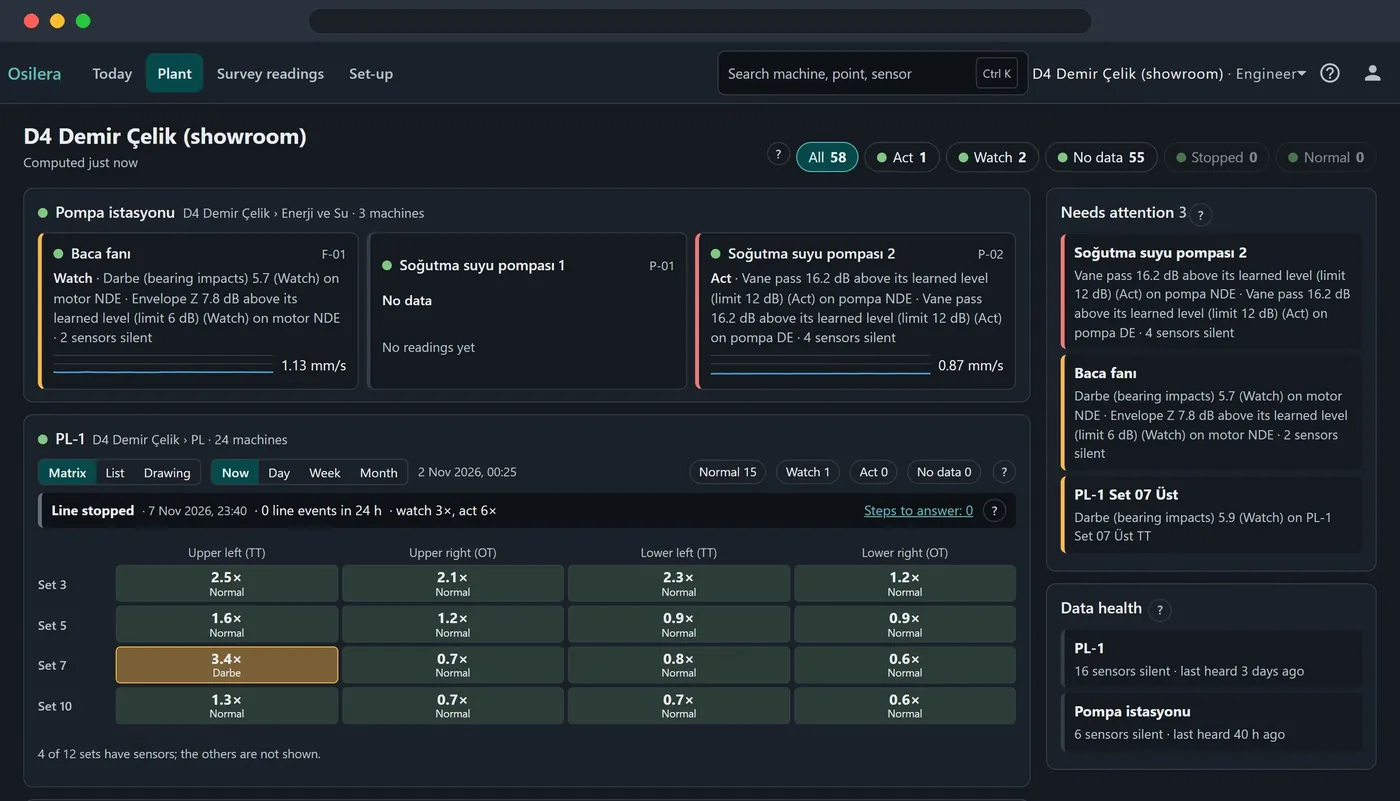
The Today screen shows the open alarms as tasks, most urgent first. Each task names the machine and point as your team knows them, and says what has risen, since when and what to do.
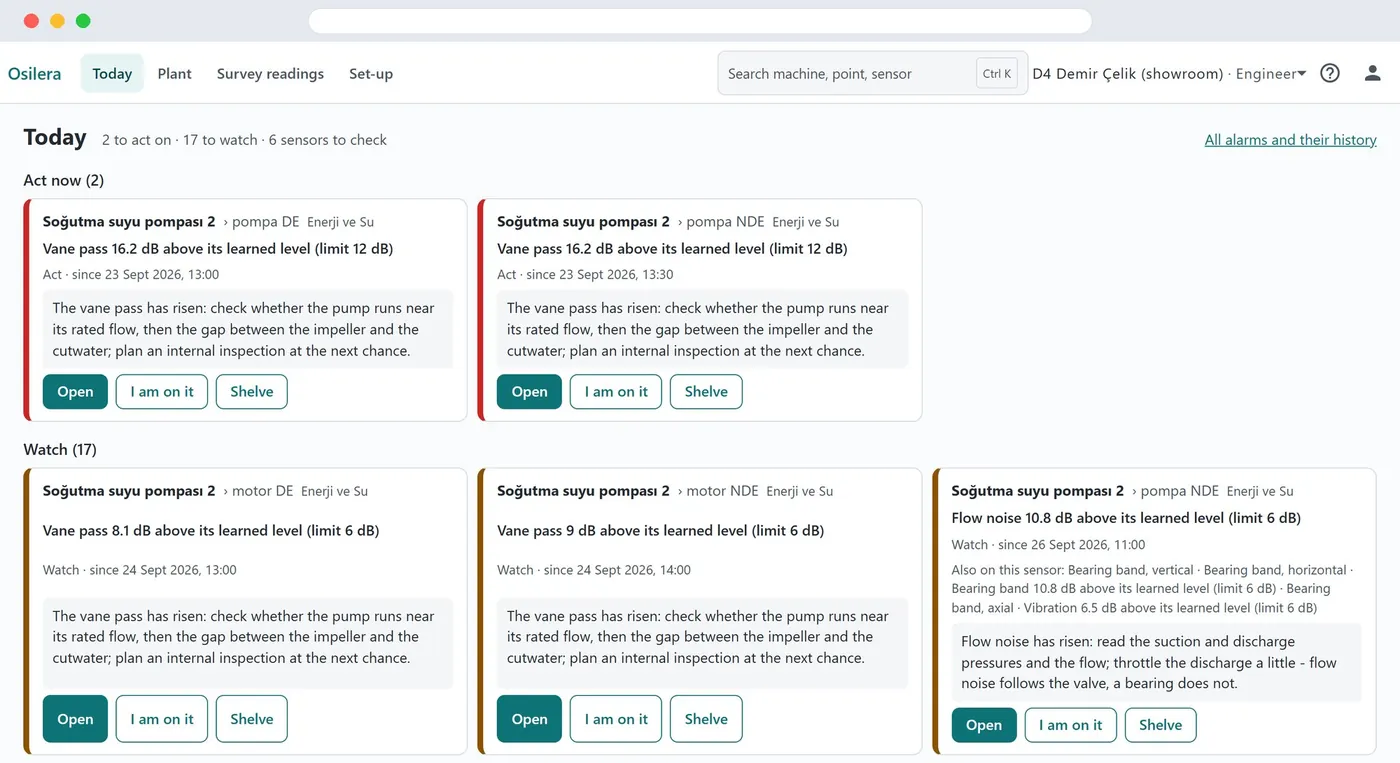
- Act now comes first, then Watch, then the sensors to check. No sorting needed.
- What to do, written for that kind of alarm.
- I am on it shows the team who has the job. Shelve hides a task for a while, with a reason.
Share the list
Each Act task gets an owner.
Check on site
The technician measures the same point with Survey. The reading sits next to the sensor's data.
Repair, then relearn
After the repair, Re-baseline lets the machine learn its new normal.
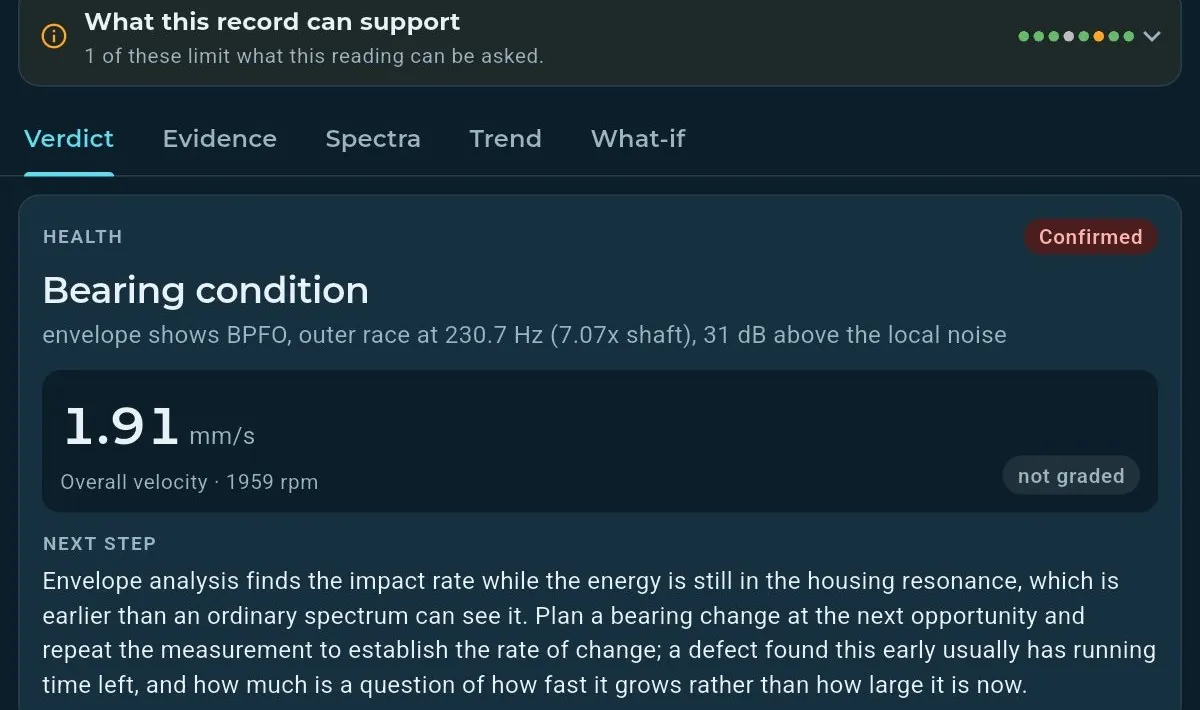
Plain answers: what is wrong, how sure, how urgent, what next.
Every machine has a health card that answers these four questions in plain words. Here a fan motor's bearing shows an outer-race fault line in 5 of its last 5 readings.

| What it looks for | In plain words | What the card tells you to do |
|---|---|---|
| Unbalance | The rotating part's weight is uneven. | Check the fixings and the foundation, then the balance. |
| Misalignment, soft foot | The motor and the machine are not in line, or a foot does not sit flat. | Check the alignment and the foot bolts. |
| Bearing wear | Impacts (Darbe) rise, or a fault line of the bearing's outer or inner ring, balls or cage appears. | Listen to the bearing, grease it if due, plan a check or a change. |
| Pump problems | The vibration of the impeller vanes, or flow noise, has risen. | Check the flow, the suction pressure and the valve first. |
| Overall vibration | Graded to ISO 20816 (pumps to ISO 10816-7). | Zone C: Watch. Zone D: Act. |
Osilera shows where to look. Confirm on the machine before major work; your maintenance team makes the repair decision.
On a roll line, the one bearing that differs stands out.
Osilera compares each roll with the others on the same line. A change that hits the whole line, such as speed or load, turns no cell amber.
Rolls and lines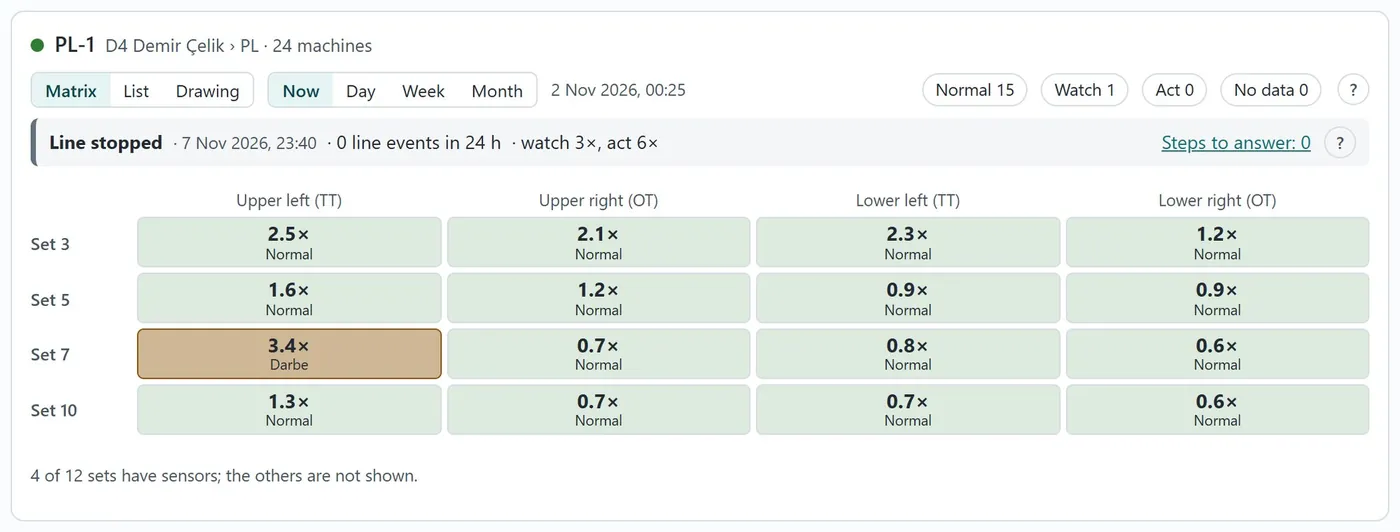
Start with your most critical machines. Grow from there.
Monitor sensors
Typically one per bearing housing on the critical machines.
A gateway and wireless routers
In the plant, for the Monitor sensors. Nothing else to install.
Survey kit
A sensor and the app on a phone or tablet, for the periodic readings.
Choose the critical machines with us, and enter or import them.
Mount the sensors and the gateway, or start measuring with the Survey app.
Osilera learns each machine's normal. Alarms start after about a day of running.
Your team works from the Today list and plans the repairs.
See your own plant in Osilera.
Ask us for a demonstration, and tell us about the machines you would start with.